APEX / PEAK
The uppermost point of a truss.
BEARING
A structural support, usually a wall,
that occurs at the top or bottom chord or between
the end points of a truss.
BOTTOM CHORD
A horizontal or inclined (ie. Scissor
truss) member that establishes the lower edge
of a truss.
BRACING
May refer to Lateral, Temporary or Permanent
Bracing indicating members installed to resist
movement.
CANTILEVER
Extension of the bottom chord beyond
its support – exclusive of overhang.
CLEAR SPAN
Horizontal distance between outer edges
of supports – also truss span.
DEAD LOAD
Any permanent load such as the weight
of roofing, flooring, sheathing, insulation, or
ceiling material, as well as the weight of the
truss itself.
DROPPED GABLE
Gable truss in which the top chord has
been dropped vertically in order to allow outlookers
to form an overhang.

GIRDER TRUSS
Truss specifically designed to carry additional
loads such as other trusses, beams or stick framing.
HEEL
Point on a truss at which the bottom
and top chords generally meet, measurement is
taken from the bottom of the bottom chord to the
top of the top chord vertically.
HIP SET
Refers to trusses used to create a hip
roof as shown in sample.
view
sample
LATERAL BRACE
A member placed and connected at right
angles to a chord or web member of a truss.
LIVE LOAD
Any loading which is not of a permanent
nature (eg. Snow, wind)
OVERALL RISE
Vertical distance from bottommost part
of the bottom chord to uppermost point of the
peak.
OVERHANG
The extension of the top chord of a truss
beyond the heel measured horizontally.
PANEL POINT
The point
where a web or webs intersect a chord.
PEAK
Point on a truss where the sloped chords
meet.
PARMANENT BRACING
Reinforcing members that are installed
in a system that are intended to remain permanently.
PIGGYBACK
Where a truss may be too tall to build
and/or deliver it may be divided into two separate
parts with a ‘piggyback’ resting on
top of a base truss.

PITCH
Inches of vertical rise for each 12
inches of horizontal run.
PLUMB CUT
Top chord at overhang is cut plumb to
the building in order to allow for installation
of fascia.
RIDGE
Line formed by truss apexes.
SLOPE
See Pitch.
SPACING
Distance between centerlines of trusses
– usually 24” O.C.(on center).
SPAN
Horizontal distance between outside edges
of supports.
SPLICE
The point at which two members are joined
to create a continuous member, a top or bottom
chord.
STUB
Reduction of overall length (or height)
of a truss without changing the remaining portion
of the truss.
TEMPORARY BRACING
Members installed to brace system during
erection and installation.
TOP CHORD
An inclined or horizontal member that
establishes the upper edge of a truss –
rafter in conventional frame.
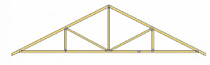
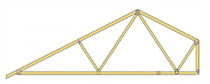
TRUSS
A self-contained triangulated frame designed
to clear span between supports.
WEBS
Members that join the top and bottom
chords to form the triangular patterns that give
the truss strength.
view
parts of a truss diagram



