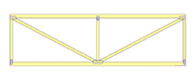
Piggyback/ Multi-Piece
Due to limitations in shipping and manufacturing,
trusses over 12 feet in height (top of truss peak
to bottom of truss tail) must sometimes be split
into two sections and put together on-site.

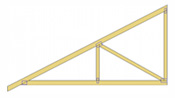
Mono Truss
A mono truss has only one slope as opposed
two (half of a common truss).
Scissors Trusses
A scissor truss is used when the ceiling
profile has an interior pitch or vault. Normally
to determined the allowable interior pitch, you
divide the exterior pitch in half. Example: if
the exterior pitch is 6/12, than the interior
pitch is 3/12. For a greater interior pitch, the
heel of the truss can be raised. (see raised heel).
A parallel chord truss (where the inside and outside
pitches match) can also be created by increasing
the heel height. A Scissor Truss can have a wide
range of vault styles, shapes and sizes.

Polynesian Truss
A Polynesian truss has a pitch change
in the top chord of the truss.
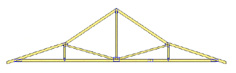
Attic Truss
An Attic truss is a common truss, with the inside
space converted into a room. This truss is often
used over a garage, or drive shed to create a
bonus room. The rooms’ width and height
are determined by the span of the truss, and the
pitch of the roof.
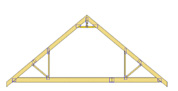
Gambrel
A Gambrel is a barn-style roof shape, and is often
referred to as a “hip” roof. These
trusses can also be designed as an attic truss
that is complete with a floor system built in.

Hip Truss
A hip truss is used to make up a cottage or hip
roof system.
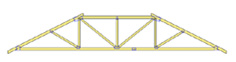
Half Hip
A half Hip truss is part of a Hip truss.
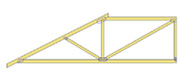
Dual Pitch Truss
A Dual pitch truss has two different pitches,
one on either side of the truss peak.
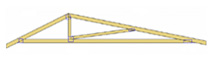
Tray or Coffer
A tray or coffer is an interior ceiling detail
that can take many forms, and is often designed
to fit inside a specific room. The design is based
on pitch, heel height and the desired appearance.
A tray or coffer detail is most often seen in
a great room, master bedroom, or kitchen in order
to give the room more height and added detail.
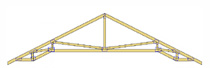
Flat Truss
A flat truss is a truss that has no exterior pitch.